
The Evolution of Motorcycle Wiring: Direct Connection vs. Power Distribution Modules
Every rider eventually catches the customisation bug. Whether it is adding auxiliary driving lights for pitch-black country roads, heated grips for winter commutes, or a loud aftermarket horn, decking out your motorcycle means adding electrical accessories. Traditionally, installing these gadgets meant wiring them directly to the battery or finding an accessory circuit. While direct wiring is straightforward for a single accessory, it quickly devolves into a chaotic "rat's nest" of inline fuses, relays, and ring terminals stacked precariously on your battery posts. This approach not only looks messy but also makes troubleshooting electrical faults a nightmare. For riders who want a cleaner, more professional electrical system, understanding the evolution from direct connection to modern power distribution solutions is essential.
The Problem with Traditional Direct Wiring
When you first start customising your motorcycle, the temptation to wire accessories directly to the battery seems logical and cost-effective. You run a wire from the positive terminal, add an inline fuse for protection, and connect your accessory. For one or two additions, this works fine. However, as most riders know, one accessory rarely stays one. After adding heated grips, you want fog lights. Then comes a phone charger, a GPS unit, and maybe some LED underglow lighting. Before long, your battery terminals become a tangled mess of wires, fuses, and connectors.
Beyond the aesthetic nightmare, direct wiring creates several practical problems. First, there's the issue of circuit protection. Each accessory needs its own fuse, and these are often mounted directly on the battery terminals or scattered throughout the bike. If a fuse blows while you're on the road, finding and replacing it becomes a frustrating roadside emergency. Second, direct wiring makes it difficult to manage power distribution. Without a centralised system, you have no way to know how much current each accessory is drawing or whether you're overloading your electrical system. Third, troubleshooting becomes exponentially harder. When something stops working, you have to trace individual wires through your entire motorcycle to find the problem.
Additionally, direct wiring can lead to premature battery drain. Without intelligent power management, accessories that should only operate when the ignition is on might remain powered when the bike is parked, slowly draining your battery. This is particularly problematic for modern riders who add multiple accessories and then wonder why their battery is dead after a week of parking.
Introducing Power Distribution Modules
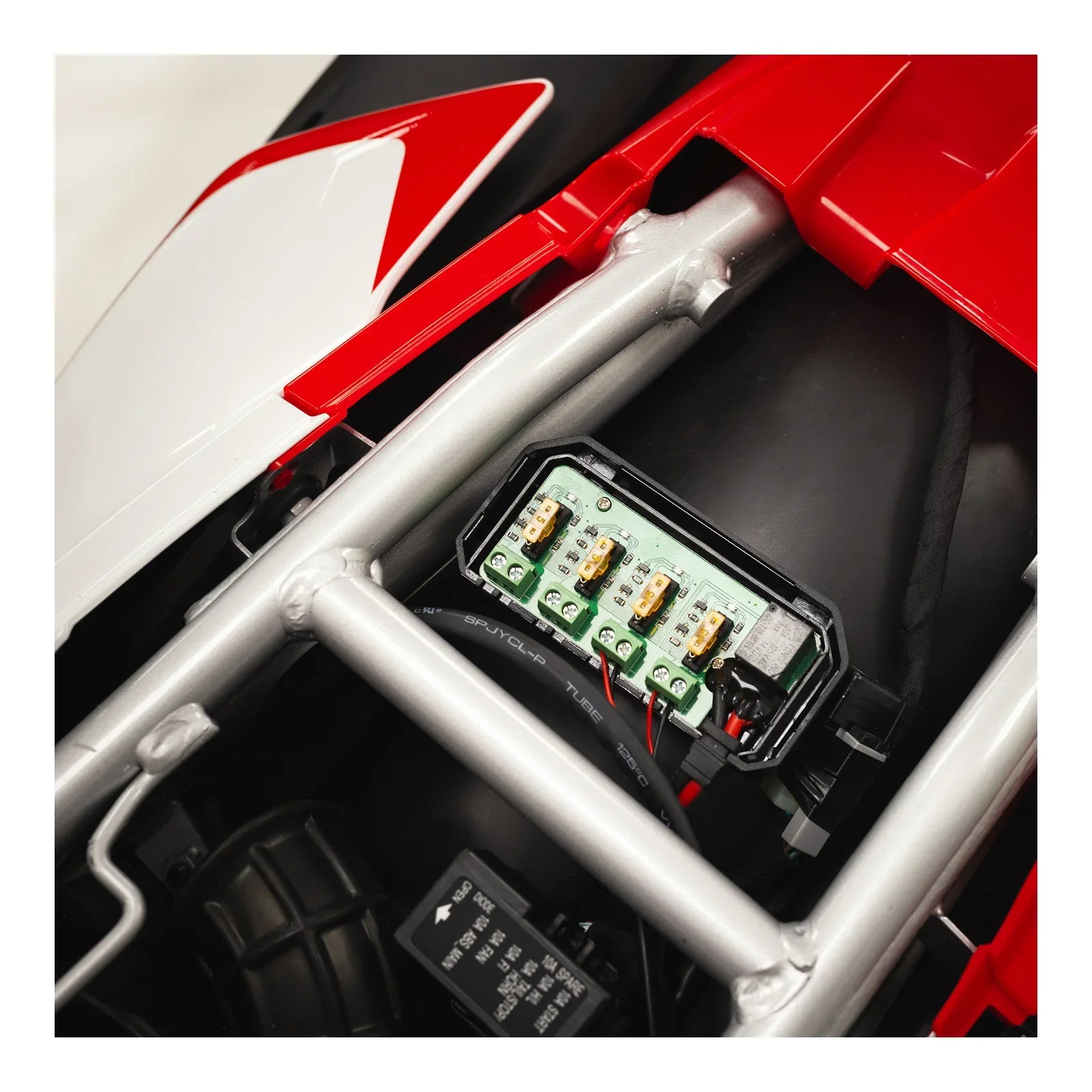
This is where a Power Distribution Module, or PDM, steps in to change the game entirely. A PDM acts as an intelligent hub between your battery and your accessories. Instead of piling wires onto the battery, you run one main power and ground lead to the module. From there, each accessory connects to its own dedicated, electronically managed circuit. The immediate merit of a PDM is the ability to individually control and monitor these circuits.
Rather than hunting down a blown glass fuse on the side of the highway, modern modules use solid-state technology to instantly reset tripped circuits, providing reliable, centralized wiring that drastically cleans up your under-seat real estate. This represents a fundamental shift in how motorcycle electrical systems are managed. Instead of a distributed, chaotic approach, you now have a centralized command center for all your accessories.
A quality PDM provides several key advantages. First, it offers superior circuit protection with automatic reset capabilities. If a circuit is overloaded, the PDM detects this and cuts power to that specific circuit, protecting your accessories and wiring from damage. Second, it enables better power management. You can program which accessories receive constant power and which only activate when the ignition is on. Third, it dramatically improves the appearance of your motorcycle's electrical system. All those messy wires and fuses are consolidated into a single, compact module.
The Garmin PowerSwitch: Next-Generation Power Distribution
Taking the PDM concept to the next level, the Garmin PowerSwitch offers riders a smart, rugged, and highly integrated solution. This digital switch box supports up to six accessory outputs. It can handle up to 30 amps for each output, with a 100-amp maximum for the entire system. Instead of drilling holes in your fairings to mount bulky mechanical switches, the PowerSwitch connects seamlessly with compatible Garmin zūmo and Tread GPS devices. This allows you to control all your 12-volt electronics directly from your navigator's touchscreen.
The Garmin PowerSwitch represents a significant evolution in motorcycle electrical management. By integrating with your GPS navigation system, it creates a unified control interface for your entire electrical system. Rather than fumbling with multiple switches or reaching under your seat to flip breakers, you simply tap your GPS screen to control any accessory. This integration is particularly valuable for adventure riders and touring enthusiasts who already rely on their Garmin zūmo or Tread 2 for navigation.
Smart App Control and Programmable Power
Even if you step away from the bike, the Garmin PowerSwitch app allows you to manipulate your lights and accessories directly from your smartphone. Imagine being able to turn off your heated grips from inside a coffee shop, or activate your auxiliary lights before you even reach your motorcycle. This level of control transforms how you interact with your bike's electrical system.
The true genius of the Garmin PowerSwitch lies in its programmability. You can dictate exactly when and how power is delivered to each device. Through the two hardwire control inputs, you can program accessories to receive constant power, or strictly turn on only after the ignition is switched on, ensuring you never accidentally drain your battery while parked. This programmable approach means your electrical system adapts to your riding style and needs.
For example, you might program your heated grips to activate only when the ignition is on. Your phone charger might receive constant power, but your heated seat only activates when you're actively riding. These programmable scenarios are impossible with traditional direct wiring and difficult even with basic PDMs.
Comparing PDM Solutions: Denali PowerHub2 and Oxford Distribution Box
While the Garmin PowerSwitch leads the market in integrated GPS-connected solutions, other manufacturers offer excellent PDM alternatives. The Denali PowerHub2 provides a robust, feature-rich power distribution system without GPS integration. It offers similar circuit management capabilities and is an excellent choice for riders who prefer standalone power management solutions.
The Oxford Distribution Box represents another solid option in the PDM market. These solutions provide centralised power distribution and circuit protection, though they lack the smart connectivity features of the Garmin PowerSwitch. For riders who want a PDM but don't need GPS integration or smartphone control, these alternatives offer excellent value and reliability.
Space Considerations and Installation
The centralised wiring of a PDM guarantees a neater, professional-looking electrical system. However, the one trade-off is the physical footprint. Modern motorcycles, especially sportbikes and stripped-down nakeds, have notoriously limited under-seat space. Measuring at 12.5 x 7.5cm, the PowerSwitch is impressively compact, but you still need to find a secure location to mount it.
Finding mounting space requires some creativity on smaller bikes. Many riders mount their PDM to the frame using vibration-dampening brackets, ensuring the module stays secure even on rough terrain. Others integrate it into custom under-seat storage solutions. The key is ensuring the module is protected from moisture and vibration while remaining accessible for maintenance.
For the serious tourer or adventure rider, dedicating this small sliver of space for an IPX7 weather-resistant module is a tiny price to pay for ultimate electrical control, peace of mind, and a flawlessly clean battery box. Adventure bikes with larger frames and more storage space have even fewer installation challenges.
The Future of Motorcycle Electrical Systems
As motorcycle technology continues to evolve, power distribution modules will likely become standard equipment rather than aftermarket upgrades. The integration of PDMs with GPS navigation systems, smartphone apps, and programmable logic represents the future of motorcycle customization. Riders will expect the same level of control and integration they enjoy in their cars and homes.
The evolution from direct battery wiring to intelligent power distribution modules reflects broader trends in motorcycle technology. Just as ABS and traction control have become standard safety features, centralized electrical management will eventually be expected on new motorcycles. For riders who customise their bikes today, investing in a quality PDM like the Garmin PowerSwitch positions you at the forefront of this evolution.
Conclusion
The journey from tangled direct wiring to intelligent power distribution modules represents a significant advancement in motorcycle electrical systems. Whether you choose the smart, GPS-integrated Garmin PowerSwitch, the feature-rich Denali PowerHub2, or the reliable Oxford Distribution Box, moving away from direct battery wiring will transform your customization experience. You'll enjoy cleaner wiring, better circuit protection, easier troubleshooting, and ultimate control over your motorcycle's electrical accessories. For any rider serious about customization, a power distribution module isn't just an upgrade—it's an essential component of a modern, professional electrical system.